Thyroid nodules are becoming increasingly common in fast-paced modern life.
Some people may notice these signals:
When emotions fluctuate, the neck feels tight, like something is stuck in the throat.
When anger rises, the neck turns red, veins pop out, and the whole chest feels tense.
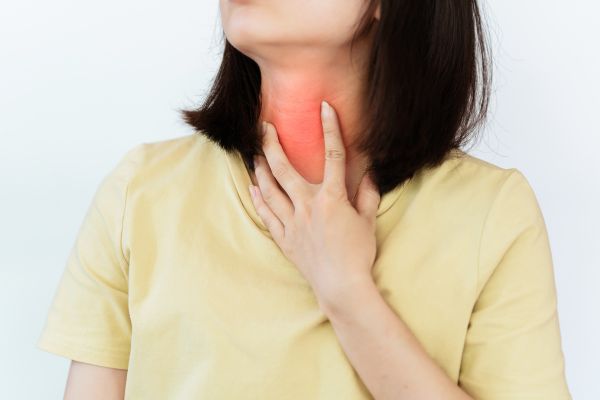
These subtle warning signs may actually be early hints of “liver-fire–related nodules” — what TCM calls “Jin Ying” or “Jin Liu”, a type of thyroid swelling associated with the liver.
In Traditional Chinese Medicine (TCM), thyroid nodules fall under “Ying Liu” (瘿瘤) — neck lumps located beside the Adam’s apple.
The root cause lies in the liver.
Long-term emotional stress can cause:
Phlegm + Qi stagnation + blood stasis combine to form firm nodules on the neck.
Jin Ying / Jin Liu (筋瘿 / 筋瘤): What Makes Them Different?
Among the five types of thyroid swellings described in TCM (Qi, Blood, Muscle, Flesh, Stone), Jin Ying / Jin Liu is closely tied to:
anger
liver fire
tight tendons (“Jin”)
hard, firm nodules
Typical features of Jin Ying / Jin Liu:
Hard lump beside the Adam’s apple
Size like a small peach pit
Greenish or purplish veins showing on the neck
Often painless
Lump may enlarge quickly with emotional stress
Severe cases may affect swallowing or breathing
This is a sign of deep liver meridian imbalance.
People with “strong bodies but strong tempers” are surprisingly more prone to this condition.
⚠️ Risk Factor 1: Lifestyle habits
You are at higher risk if you:
Common symptoms:
Risk Factor 2: Emotional patterns
People who are easily affected emotionally are more prone to liver stagnation:
Irritable, easily angered
Constant stress or high pressure
Women experiencing PMS flares
Common emotional-related symptoms:
Face turns red when angry
Neck veins become visible
Chest tightness or sighing
Headaches or dizziness
If these describe you, early regulation is essential.
These techniques combine acupressure, moxibustion, and meridian stretching.
1. Acupressure: “Point Press & Release” Method
Key acupoint: Qishe (气舍穴)
Location:
On both sides of the neck, above the clavicle, between the two heads of the sternocleidomastoid muscle.
How it helps:
Clears liver-fire
Moves stagnant Qi
Softens hardness and disperses phlegm
How to do it:
Place your finger on Qishe.
Inhale → light touch
Exhale → press deeper and gently rotate
Feel a comfortable “sore–numb–heavy” sensation
Duration:
2–3 minutes each time, 2–3 times daily.
Use especially when stressed, angry, or when the neck feels tight.
2. Moxibustion: Warming the Liver & Dissolving Nodules
Recommended points:
Qishe (气舍) — for neck stagnation
Ganshu (肝俞) — major point for liver balance
How to do it:
Qishe:
Hold moxa 2–3 cm from skin
Warm for 5–10 minutes
Ganshu (back):
Warm for 10–15 minutes
You may need assistance locating it
Frequency:
2–3 times per week, 20–30 minutes each session.
Do NOT use moxa if the lump is red, hot, or inflamed.
See a professional instead.
3. Dao-Yin Stretching: Liver & Gallbladder Meridian Stretch
This stretch targets the side of the body — the pathway of the Gallbladder Meridian and Liver Meridian.
How to do it:
You should feel a gentle stretch along your side.
Reps:
2–3 sets per side
Once or twice daily
Do NOT overstretch or force the body.
Guo An Tang TCM Clinic
Any questions related to TCM Guide: Unblock the Liver Meridian to Shrink Thyroid Nodules?
Jurong West Branch
Make an appointment.
Jurong East Branch
Make an appointment.
APAC Branch
Make an appointment.
Tiong Bahru Branch
Make an appointment.
Bukit Merah ABC Branch
Make an appointment.
🟢 we are online | privacy policy
WhatsApp us